
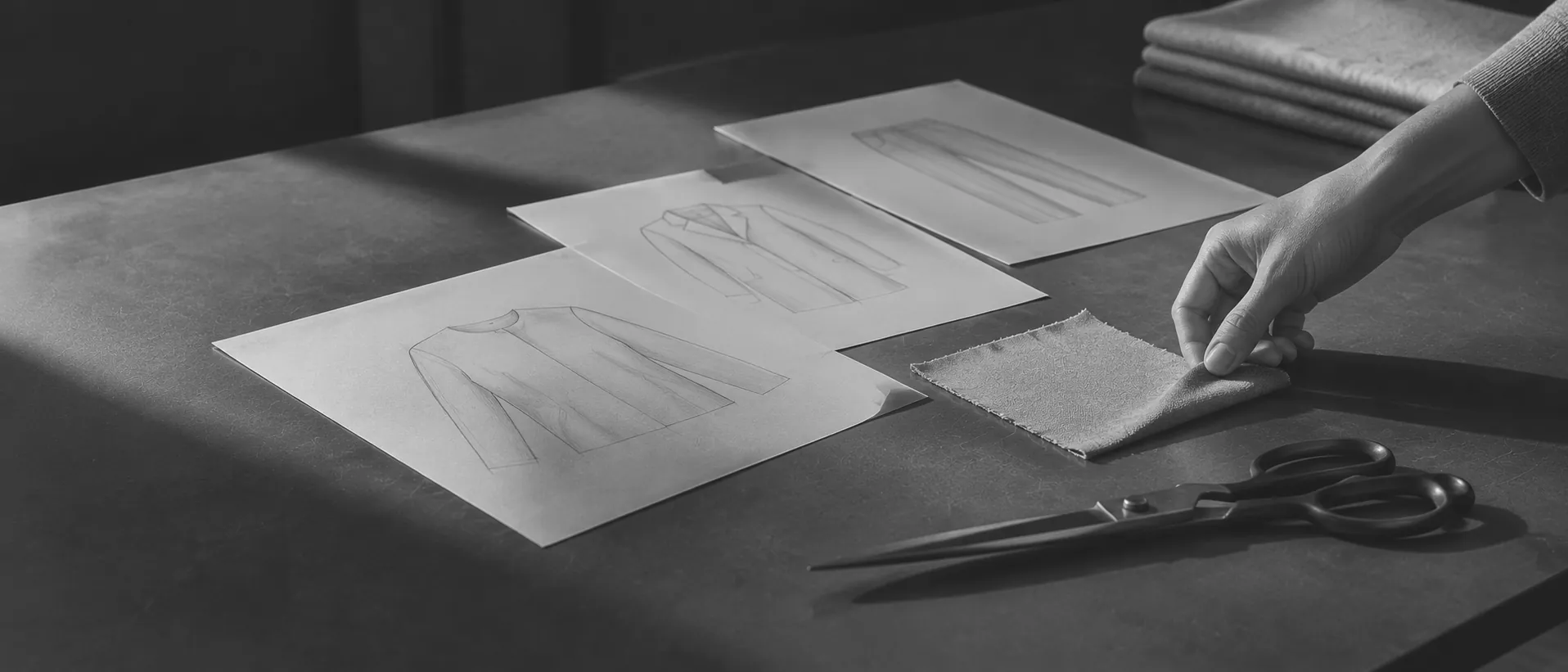
The hand may change. The thinking must still know where it is going.
From research to production: what artificial intelligence can really do in the work of fashion designers, what it cannot, and the responsibilities it brings.
01 — Not a New Season, a New Level of Design
Artificial intelligence enters the fashion system through many doors: visual research, creative development, demand forecasting, materials inspection, technical document handling, production organization. Talking about it as a block, as if it were one thing, is the most frequent mistake, because it puts on the same level tools with very different functions, maturity and consequences.
Generating the image of a coat does not mean having developed its pattern. Predicting which products might sell does not mean knowing which quantities to produce. Recognizing a defect on a surface does not mean deciding whether the garment is acceptable.
Fashion is not just a system of images. It is a process in which an aesthetic intention must become a physical product, with measurements, costs, times, materials and production constraints. The right question, then, is not whether AI can replace the designer. It is which parts of the work it can do, which it can speed up and which still require knowledge and experience.
One sentence sums up the point well: the designer's way of thinking stays, only the hand changes. It is largely true, but it is not enough. When the tool changes, so do the possibilities you can explore, the speed of versions and, sometimes, the very way a problem is framed.
02 — Four Artificial Intelligences
There is no single AI applied to fashion. There are different families, and they act at different moments of the product cycle.
Generative AI is the most visible
It produces images, silhouette variants, color combinations, designs for fabrics, text. In style research it helps explore directions, build moodboards, relate materials and forms, and quickly see alternatives to an initial idea. Studies on generating knitted surfaces show real possibilities, but do not prove that a generated image translates by itself into a textile structure that can be made in a factory. Creating the image is a concrete capability. Matching image, structure, material behavior and finished product is a separate problem.
Predictive AI works on data
It uses sales history and other variables to estimate demand, plan assortments, distribute quantities and manage stock. But forecasting in a sector made of seasons, variety and short commercial cycles is hard, and the limit is not only the algorithm's: a forecast is worth as much as the data it rests on, and a cultural shift, a new trend or something unforeseen makes the past less representative. AI improves how numbers are read. Commercial uncertainty remains.
Computer vision looks at what the eye must check
On fabrics it can recognize surface defects, weave irregularities, stains, color variations. It is technically concrete, but it depends on shooting conditions, the type of material, lighting and the data the system was trained on. It may fail to recognize a new or infrequent defect. And above all: recognizing an anomaly does not mean deciding whether that anomaly makes the material unusable.
Technical assistance is the least spectacular and perhaps the most useful day to day
Generative systems can read documents, extract information, fill in fields, reorder data and prepare first drafts of tech packs, bills of materials, material descriptions, measurement tables, cost comparisons. But assisting documentation is not validating it. A system can organize a bill of materials without knowing the garment's correct composition; it can produce a cost estimate without knowing real prices, waste and the supplier's terms. Today an autonomous, reliable management of the whole technical development, from drawing to approved costing, cannot be considered proven. More realistic is partial automation, with support for documentation and structured data.

03 — What Works and What Is Still a Demonstration
A technology's maturity is not measured by the quality of a presentation or the precision of an image. A result becomes significant when it can be repeated, verified and used inside a real process.
In fashion there are already documented applications of demand forecasting, textile defect recognition, surface generation and information analysis. Research shows these fields have concrete technical foundations. It does not show that every application is ready to be integrated without supervision into any production setting.
The same reasoning applies to expectations. When many executives say they expect a lot from a technology, that is a fact about expectations: it says where the sector is looking, not how many companies have already adopted it successfully.
Some distinctions are worth never losing. Simulating a garment on an avatar does not certify the fit of the real product. A generated design does not prove that a machine can make it. The image of a fabric does not convey weight, hand, stretch or behavior. The border between demonstration and industrial application lies in verifying the result.
04 — The Designer Is Not an Image Generator
To understand what changes in creative work you need to tell four activities apart: research, interpretation, connection and evaluation.
Research gathers stimuli, references and information. AI can widen this field very quickly, but the risk is mistaking the quantity of results for the quality of research. Interpretation is the moment when the gathered material makes sense: a historical reference, a surface, a social behavior, a functional need become parts of a project. AI can help compare the information, but it does not guarantee that the connection it proposes is culturally relevant. Connection links elements born in different contexts: a use need and a form, a material and a construction, an aesthetic sensibility and a production solution. Evaluation, finally, decides whether the result is consistent with the initial intention and whether it can become a real product.
AI can take part in all four, but it does not by itself have the criteria to govern them.
An example. A designer wants to develop a lightweight jacket with an essential construction, in a technical material with a compact surface. In the traditional method they start from references, materials, sketches and samples, and develop the alternatives one after another. With AI they can add an initial phase of exploration: see different proportions, compare collars, pockets and volumes, try some color pairings. They choose a direction, correct the proportions and turn it into a design drawing.
At this point the process changes level. The material must be identified, the construction defined, the seams checked, the measurements developed and the garment taken to fitting. AI has cut the time needed to explore some alternatives. It has not solved the technical decisions that turn a proposal into a product.
This is where you see the difference between having a tool and having a method. A tool produces possibilities. A method decides why some deserve to be developed and others must be discarded.
05 — The Risk of Sameness
An image generator can produce a great many alternatives, but quantity does not guarantee originality. Generative models learn from large sets of data, and their answers depend on what they have seen and the instructions they receive.
If they are used without a precise design direction, they tend to favor recurring solutions: already recognizable silhouettes, familiar proportions, predictable surfaces, aesthetic combinations that point to a shared imagery. The result can be convincing in form and not very distinctive.
It is not a problem only of AI: traditional design can repeat itself too. But automation can multiply the speed at which similar solutions are produced and spread. The greater risk is not that everyone uses the same technology. It is that everyone ends up accepting the same statistically plausible answer as good.
That is why visual culture, knowledge of fashion history and the ability to recognize what has already been done become even more important.
06 — Rights, Transparency, Data: The Concrete Risks for a Brand
Using AI brings issues that are not only about creativity. Here you will find the principles, not a legal opinion.
Copyright. In Europe, copyright rules provide an exception for the automated analysis of lawfully accessible content, provided the rights holder has not expressly reserved its use, including through machine-readable means. European rules on artificial intelligence also ask model providers to state how they respect copyright and to give a summary of the content used for training. This does not mean every model is compliant, or that using protected material is always authorized. In the United States, for example, a work created solely by a non-human system receives no protection: a recognizable human creative contribution is needed, and a simple text prompt, by itself, is not enough. The question of using protected works to train models remains open, with no rule valid for every case.
For a brand the questions are concrete: who made the image? Which materials were used? How much was really designed by a person? Which rights can be granted to third parties?
Transparency. European rules introduce transparency obligations for content generated or manipulated by AI, including machine-readable marking and the disclosure of certain synthetic images and recordings. They come into application in stages and with exceptions, so dates and scope must always be checked at the moment of use. Not every image generated in a creative context carries the same obligation towards the public: the type of content and the context of publication matter.
Supplier data and confidentiality. A tech pack can contain commercially sensitive information: prices, purchasing terms, names, material specifications, bills of materials, measurements, processes, supply chain data. Uploading it to an external service without knowing its terms for processing, storing and reusing data can expose information that was meant to stay confidential. The rules protect know-how and confidential business information when secrecy, commercial value and reasonable protection measures are present, and regulate personal data processing separately.
Errors that reach production. A wrong figure in a technical document does not stay a digital error. A wrong measurement becomes an out-of-tolerance garment. A component described imprecisely is bought in the wrong version. The risk is not only that AI gets it wrong. It is that a result that looks tidy is taken as correct without independent checking.
These are general considerations and do not constitute legal advice. For commercial uses, contracts, licenses and data processing, consult a specialized professional.
07 — What You Do Not Delegate: Material, Fit, Feasibility
Some aspects of a design cannot be fully verified with an image or a description.
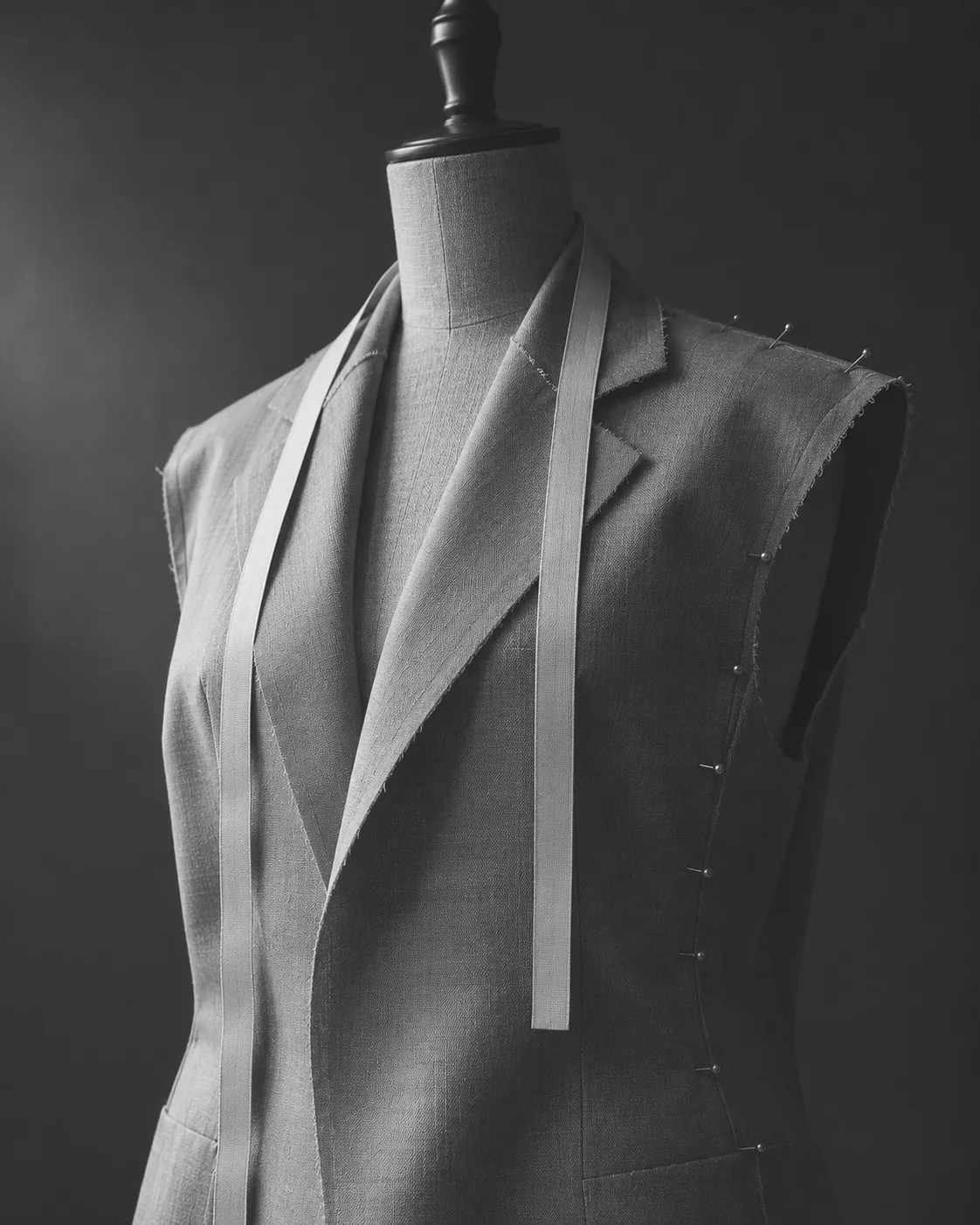
Material is one of them. A fabric is not just a color or a surface: it has weight, hand, stretch, memory, strength, behavior in cutting and response to processing. An image can show a glossy, compact black, but it does not prove that the chosen material really has that consistency or suits the imagined construction.
Fit has a similar limit. A generated silhouette can be convincing. It does not prove the proportions are right, that the garment allows movement, that the measurements are consistent or that the volume works on different bodies. The try-on remains a physical step.
Feasibility too requires concrete knowledge. A construction may look simple in an image and turn out complex once you consider seams, machines, work sequences, material availability and the skills needed. Someone who knows production recognizes these problems before they become costs.
This is where technology meets the work of the fashion technologist, the pattern maker, the product manager and the skills of the supply chain. AI can help analyze and prepare information. It does not replace the experience needed to interpret it.
08 — What This Means for Anyone Designing Today
AI changes the relationship between intention and result. Some operations get faster: visual research widens, information is organized sooner, some repetitive tasks are automated. This does not make design skill less important. It changes how it is distributed: value moves from producing alternatives to framing the right problems, choosing reliable information, recognizing errors and checking the coherence between design and product.
For a designer, a stylist or a product manager, AI can become an extension of the work, as long as it is introduced at a precise stage and with a precise purpose. In research it helps explore directions and compare alternatives. In development it helps organize information and documents. In planning it helps read the data. But every step needs a criterion for checking.
A reasonable path might be this: start from a defined design intention, use AI to widen the possibilities, choose and correct, translate the choice into technical specifications, verify materials and construction, develop the prototype and check the result with a try-on and a comparison with production.
The point is not to use artificial intelligence at every stage. It is to know when its intervention gives a real advantage and when it only adds complexity. A professional will need to understand not only what to ask a system, but also which information they can share, which results they can use and which decisions must stay with a person.
A designer's skill is not the same as the ability to draw quickly. It includes visual culture, sensibility, interpretation, knowledge of materials and the ability to turn an intention into something that can be made.
The hand may change. The thinking must keep knowing where it is going, and it must also learn to recognize when the tool is not only speeding up the path, but changing it.
The difference between an image and a product will always be a sequence of choices.
Knowing what AI can generate is the easy part. Knowing which of it can become a product, and under whose responsibility, is the work.
Open — 1 of 3 client spots available. I work with a limited number of clients at a time, so every project gets real attention.
Talk through AI in your workflow →