
Thinking about Fashion
Theories, thinkers and tools for understanding design culture.
Fashion cannot be explained by a single theory, because it is not born from a single process. It is imitation and distinction, consumption and communication, collective selection and cultural construction. It is also a material system: it turns ideas and meanings into objects, through design, technologies, skills and production.
Tools, not stages
The thinkers on this page are not stages in a linear history of ideas. They are different interpretive tools, to be related and, when needed, set against one another: nine authors from sociology, philosophy and the study of consumer culture, plus Bruno Munari as the Italian reference for design culture.
Why we need theories to understand fashion
Fashion is often told through the people who made it, the collections, the garments and the shifts in taste. But describing what happened is not the same as understanding why.
Why is a way of dressing adopted? Why do some objects acquire social value regardless of their function? How does a collective taste form? And why can a product be desired not for what it is, but for what it represents?
Sociologists, philosophers, economists and scholars of culture asked themselves these questions throughout the twentieth century, and their answers do not coincide. For some, fashion is a mechanism of social imitation; for others a process of collective selection; for others still a language, a system of signs, an instrument of distinction or an expression of modernity.
These theories have a concrete use in design as well. They help read the context before developing a product, understand why a form works in a certain environment, and tell material value from symbolic value. For those who work on product, they add a dimension to research: not only what can be made, but why someone might recognize themselves in that object.
Georg Simmel: imitation and differentiation
1858–1918 · Sociology · Imitation / Differentiation
A German sociologist and philosopher, Simmel studies the forms of social relations and the behavior of modern society. His essay on fashion appeared in English in 1904 and in German, as Philosophie der Mode, in 1905; he took it up again in a revised version in 1911.
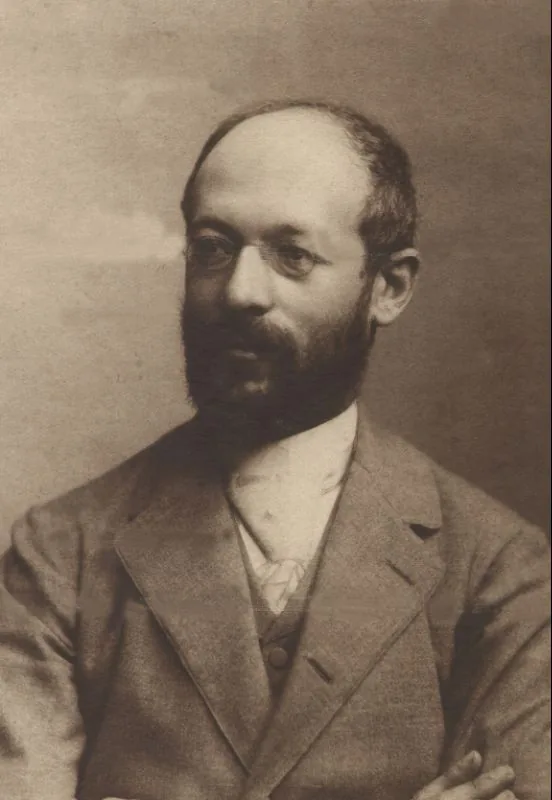
For Simmel, fashion answers two contemporary needs: to belong to a group and to stand apart from others. The individual imitates recognizable behavior because it allows participation in a community, but also looks for differences that make their own position visible. The mechanism is dynamic: when a form is adopted by wider groups it loses part of the distinctive power it had at the start, and those who want to keep a difference look for others. Fashion feeds on this tension between conformity and individualization.
A recurring misunderstanding credits him with a complete theory of trickle-down. His thinking does contain a mechanism of imitation and differentiation between social groups, but reducing it to a simple movement from top to bottom impoverishes its scope.
Key work. Fashion (1904); Philosophie der Mode (1905).
Limits and criticism. Simmel’s reading is often reduced to the model in which lower classes imitate higher ones. A closer reading shows that for him fashion is a broader social form, tied to the construction of groups and to metropolitan life. On the other hand, the original model gives great weight to class distinction and on its own does not describe every contemporary process of diffusion.
Application to design. When developing a product it is useful to ask which belonging it makes recognizable and which difference it introduces. A garment can be familiar enough to be understood and specific enough not to be confused with what already exists.
Thorstein Veblen: conspicuous consumption and social value
1857–1929 · Economics and sociology · Conspicuous Consumption
An American economist and sociologist, Veblen published in 1899 a critical study of the American leisure class and of the behavior through which it makes its economic position visible.
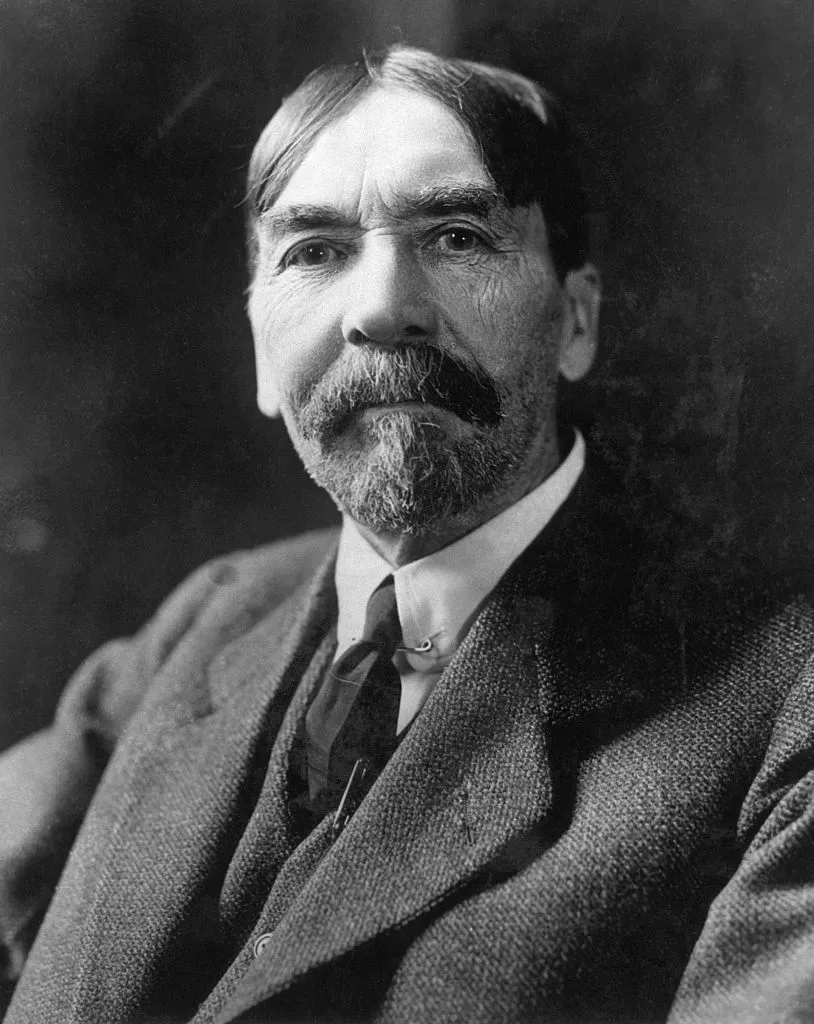
His theory introduces two concepts: conspicuous consumption and conspicuous leisure. In conspicuous consumption the good does not only meet a need: it becomes a public demonstration of the owner’s economic capacity. Clothing is especially effective because it stays constantly exposed to the gaze of others. Veblen also notes the social value of apparent waste: costly materials, elaborate workmanship, time spent in unproductive activities and difficulty of upkeep can become signals of economic means. Price, then, is not always only a cost: it takes part in building the meaning of the product.
Key work. The Theory of the Leisure Class (1899).
Limits and criticism. The model comes from observing late-nineteenth-century American society. Not every form of desire comes down to displayed wealth: an object can be valued for skill, cultural belonging, function or personal meaning. And conspicuous consumption alone does not explain why a certain form is recognized as desirable.
Application to design. The designer can tell real cost from perceived value. A fine material does not communicate quality automatically: it has to be recognizable through texture, workmanship, proportions and details. And even an essential product can carry strong symbolic value without resorting to ostentation.
Herbert Blumer: collective selection
1900–1987 · Sociology · Collective Selection
An American sociologist and a central figure of symbolic interactionism, Blumer studies how social meanings emerge from interactions between individuals and groups. In 1969 he published Fashion: From Class Differentiation to Collective Selection, one of the most important contributions to the revision of classical theories of fashion.
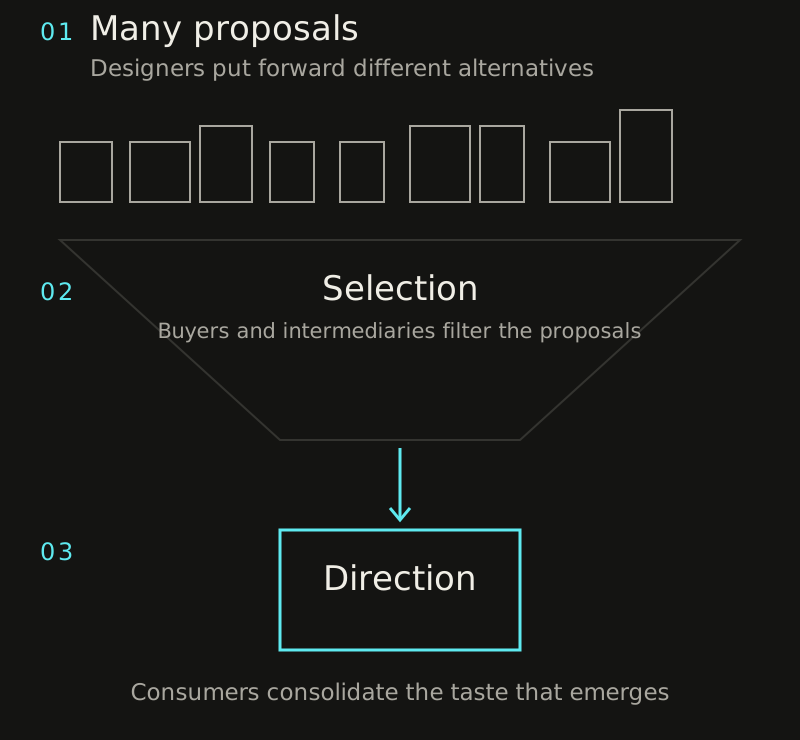
Blumer argues that fashion is not necessarily born because a prestigious group imposes a model on the others. It is also born from competition between different proposals and from the gradual selection of those that seem to interpret best the direction of emerging taste. In the system he observes, designers put forward alternatives, professional intermediaries select, and consumers help consolidate a direction. Fashion is therefore a social process, not only an individual decision or a strategy of the elites.
Key work. Fashion: From Class Differentiation to Collective Selection (1969).
Limits and criticism. Blumer mainly observes the Parisian women’s fashion system of his time. His model clarifies the relationship between creators, buyers and the public, but does not fully develop the relationship between economic conditions, production structures and the formation of tastes.
Application to design. Product research should not stop at collecting images that are already popular. It has to compare alternatives, recognize recurrences, test which forms answer emerging needs and tell a passing trend from a more structural change.
Grant McCracken: the movement of meanings
Cultural anthropology · Cultural Meaning
A cultural anthropologist, McCracken studies the relationship between culture, consumption and the meaning of objects. His contribution developed in the 1980s, with studies on the symbolic workings of consumer goods.
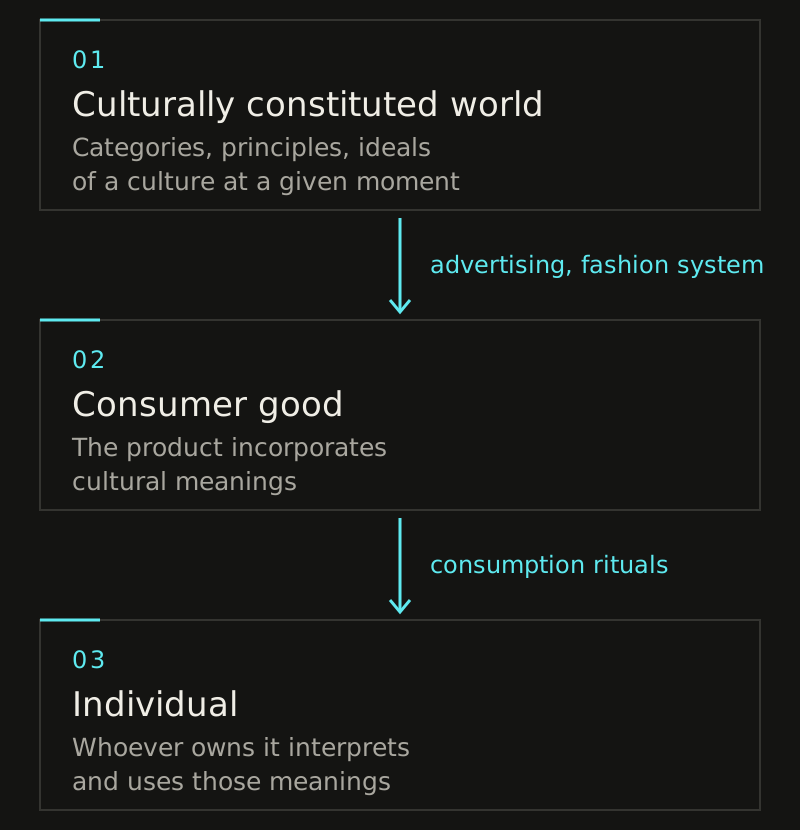
In The Trickle-Down Theory Rehabilitated (1985) he critically revisits the model of vertical diffusion in fashion, questioning its overly simple versions. In the later Culture and Consumption (1986) he offers a broader explanation: cultural meaning moves from the socially constructed world to goods and, through consumption practices, to individuals. Advertising, the fashion system and consumption rituals play a role in this movement. The product is not a neutral container: it can embody cultural meanings that its owner interprets and uses.
Key work. The Trickle-Down Theory Rehabilitated (1985); Culture and Consumption (1986).
Limits and criticism. The transfer of meaning is very useful for understanding symbolic consumption, but it does not describe the material conditions that make a product possible: on its own it does not explain cost constraints, material availability, production skills or industrial decisions. Its original formulation, moreover, concerns the North American cultural system of consumption.
Application to design. During development it is useful to ask what meaning is built into the product and through which elements: silhouette, material, color, finish, function, way of use. Communication can make these elements legible, but it cannot replace their real coherence.
Pierre Bourdieu: distinction and cultural capital
1930–2002 · Sociology · Distinction / Cultural Capital
A French sociologist, Bourdieu analyzes the relationship between social position, education, culture and the construction of taste. His research on distinction came out in France in 1979.
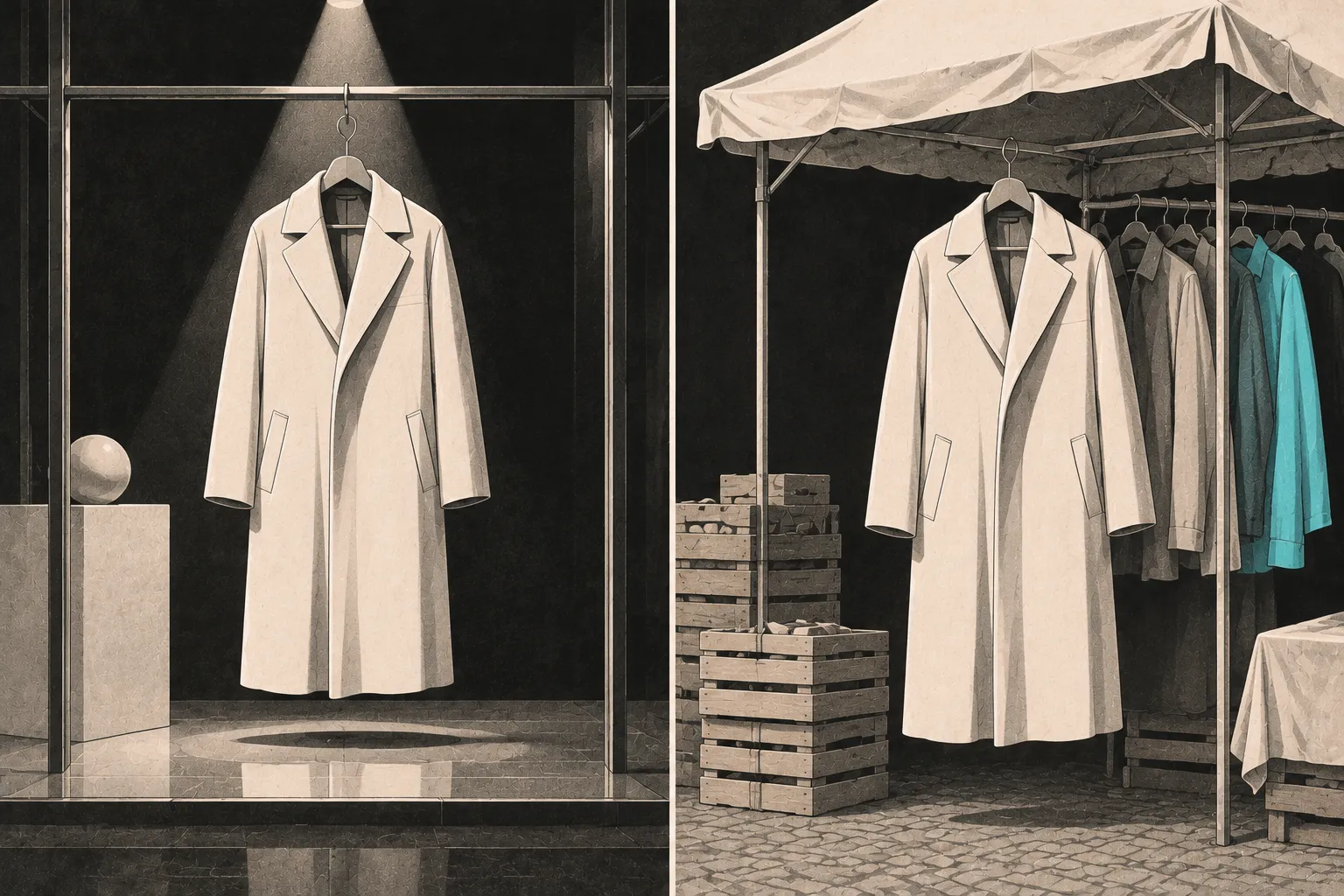
In La Distinction he shows that taste is not a simple individual preference: it is also formed through social conditions, education and accumulated experience. Three concepts are fundamental. Habitus is the set of dispositions and schemes of perception acquired through social experience; cultural capital includes knowledge, skills and familiarity with certain codes; the field is the social space in which individuals and groups occupy different positions and compete for recognition. Applied to fashion, this perspective explains why the same form can be considered refined in one environment and inappropriate in another: aesthetic value is also a matter of shared codes and social recognition.
Key work. La Distinction: Critique sociale du jugement (1979).
Limits and criticism. The research rests on surveys carried out in France in the 1960s and cannot be transferred automatically to societies with different social and cultural structures. Later applications have discussed and extended the relationship between capital, taste and identity, showing the need to consider different historical and social contexts.
Application to design. Before defining a product you have to identify its cultural context. It is not enough to decide whether a garment is aesthetically interesting: you need to understand which codes it uses, to whom they are familiar and what recognition they can generate.
Roland Barthes: fashion as a system of language
1915–1980 · Semiology · Fashion System
A French semiologist and literary critic, Barthes applies the study of signs to contemporary culture. His work on fashion focuses on the language with which magazines describe and represent clothes.
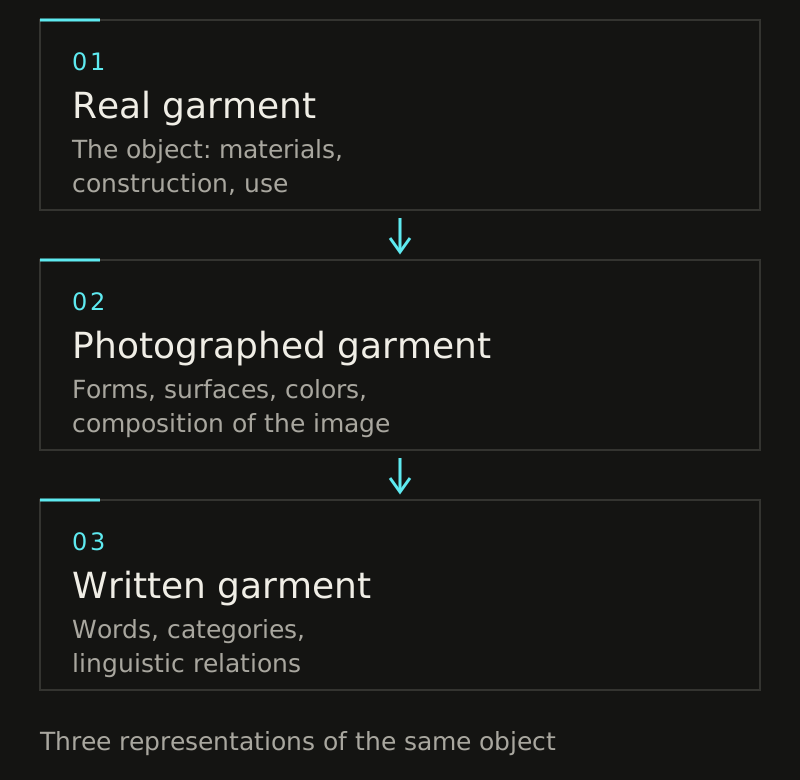
In Système de la mode (1967) he writes neither a history of clothes nor an analysis of designers’ work: he studies how fashion is turned into language through magazine descriptions. He distinguishes three levels: the real garment, the photographed one and the written one, three representations of the same object that do not work in the same way. The photographed garment communicates through forms, surfaces, colors and composition; the written one through words, categories and linguistic relations. Editorial language does not merely describe the product: it helps construct its meaning.
Key work. Système de la mode (1967).
Limits and criticism. Barthes’s corpus is limited to French magazines of 1958–1959, and his method does not directly describe design, making or the material experience of the garment. Photography, digital communication and visual representation have also changed the codes with which fashion is told.
Application to design. A designer must also consider the legibility of the product. A seam, a pocket, a volume or a material can communicate something before any description steps in. Photography and words must make the project understandable without attributing qualities it does not have.
Walter Benjamin: fashion, time and reproducibility
1892–1940 · Philosophy · Modernity / Obsolescence
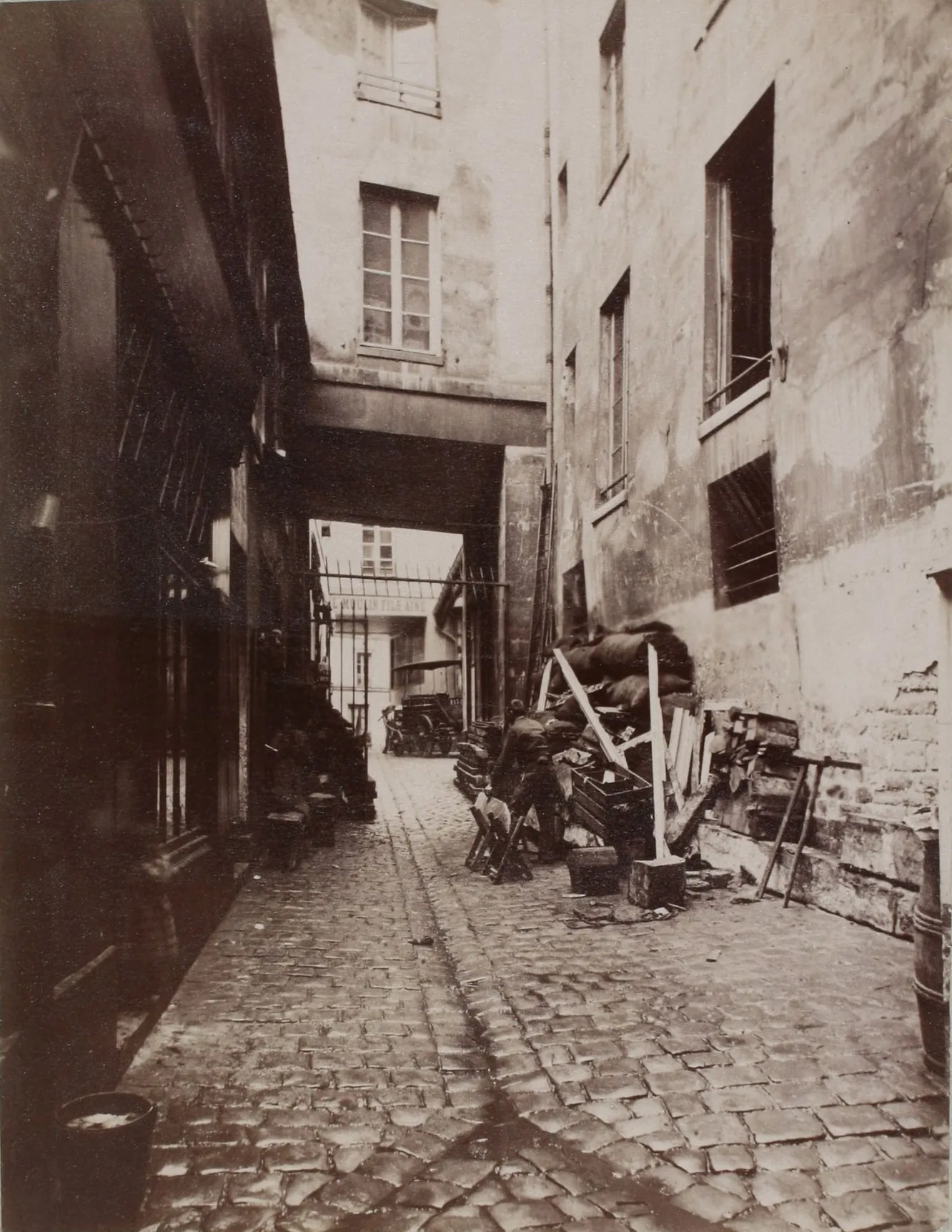
A German philosopher and cultural critic, Benjamin studies the transformations of modernity, material culture, images and the relationship between production and perception. His project on the Parisian passages occupies the years from 1927 to 1940 and remained unfinished at his death.
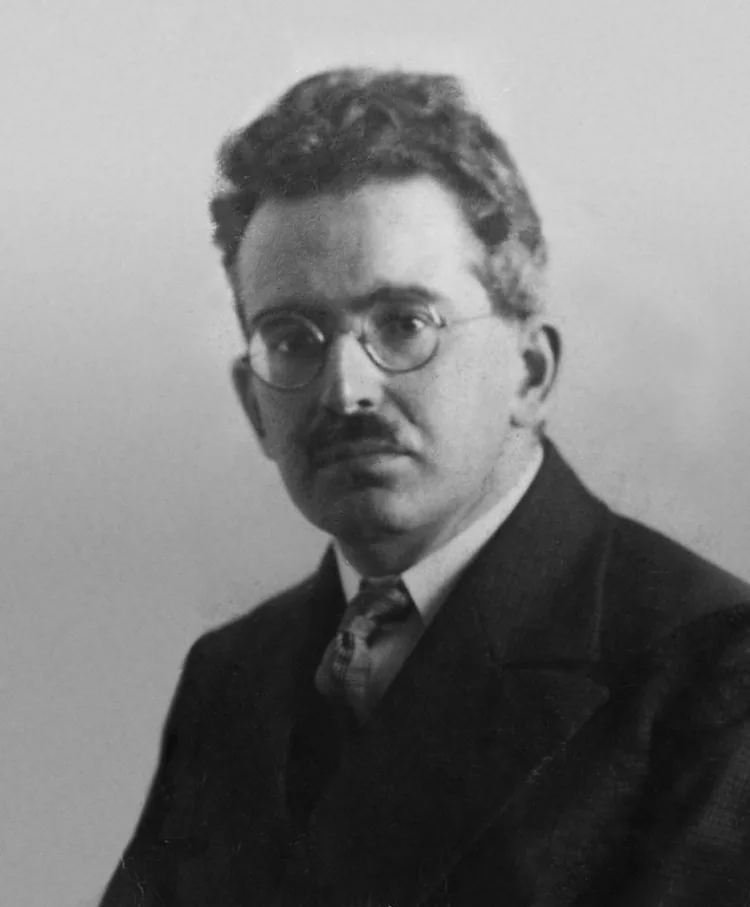
In the Passagen-Werk (The Arcades Project) he uses objects, architecture, advertising images and testimonies of nineteenth-century Paris to interpret the birth of modern consumer society. Fashion appears there because it makes visible the relationship between novelty and obsolescence: what looks contemporary can soon become outdated, but it is precisely abandoned objects and forms that let us read the aspirations and contradictions of an age. The product is not only the result of a creative moment, it is also a material trace of an economic and cultural system.
Key work. Das Passagen-Werk (materials 1927–1940, posthumous publication); Das Kunstwerk im Zeitalter seiner technischen Reproduzierbarkeit (versions from the 1930s).
Limits and criticism. The passages project is fragmentary and is not a systematic theory of fashion: interpreting it requires connecting heterogeneous materials. And technical reproducibility mainly concerns the transformation of the artwork and of its experience through the means of reproduction; it should not be confused with a general theory of the industrial production of clothing.
Application to design. Archives, sample books and products of the past can be read as technical and cultural documents. Studying an earlier garment means understanding not only its form but also the technologies, expectations and conditions that made it possible.
Jean Baudrillard: the product as sign
1929–2007 · Philosophy and sociology · Sign-Value
A French philosopher and sociologist, Baudrillard studies consumption, media and the systems of signification of contemporary society. His first works date from the late 1960s.
For Baudrillard, objects are not bought only for utility or price: they also have a value tied to the position they occupy in a system of signs, sign-value. A garment can be desired for its social meaning, for the image it communicates or for its relationship with other objects and cultural codes. In La Société de consommation (1970) he widens the critique of consumption: objects take part in a system in which identity, prestige and differentiation are constantly built through goods.
Key work. Le Système des objets (1968); La Société de consommation (1970); Pour une critique de l’économie politique du signe (1972).
Limits and criticism. The theory of sign-value risks giving excessive weight to symbolic systems, leaving the material conditions of consumption in the background, and does not develop a real theory of the individual as an autonomous subject able to produce and transform signs.
Application to design. A product should be analyzed on two levels: what it does and what it communicates. A solution can be technically effective yet not coherent with the context in which it is offered; conversely, a highly recognizable product may fail to meet the expectations created by its image.
Gilles Lipovetsky: fashion as a regime of modernity
1944– · Philosophy · Ephemerality / Individualism
A French philosopher, Lipovetsky studies individualism, modernity, consumption and the transformations of contemporary society. In 1987 he published his best-known essay on fashion.
In L’Empire de l’éphémère he interprets fashion as one of the central expressions of modernity. It does not concern clothing alone but a cultural system founded on novelty, transformation and individual freedom: fashion becomes the mechanism through which modern society accepts change as a normal condition, and the coexistence of different styles and the possibility of building individual identities gain a growing role. Attention shifts from social hierarchy alone to the transformation of behavior and of the forms of individualization.
Key work. L’Empire de l’éphémère. La mode et son destin dans les sociétés modernes (1987).
Limits and criticism. Lipovetsky’s reading has been debated above all for how it interprets individualization and the weakening of collective constraints: to what extent does greater freedom of choice really mean overcoming social conditioning? Being able to choose among many styles does not necessarily remove hierarchies and mechanisms of recognition.
Application to design. The designer has to tell novelty from durability. Not everything that looks new produces a meaningful change. Effective research can combine temporary elements with characteristics able to hold their value even when the aesthetic context changes.
Bruno Munari: designing as a method of knowledge
1907–1998 · Italian design · Design Method
An Italian artist and designer, Munari developed a body of research spanning graphics, objects, visual communication, publishing and the teaching of design. His fundamental texts include Arte come mestiere (1966), Design e comunicazione visiva (1968) and Da cosa nasce cosa (1981).
Munari does not propose a sociological theory of fashion. His contribution is different: he studies how a project is built through observation, analysis, experimentation and verification. In Da cosa nasce cosa he tackles the problem of design method, showing the importance of breaking a problem down into understandable elements before choosing a solution. Creativity is not opposed to technical knowledge: the project arises from the interaction between expressive possibilities, materials, functions and concrete conditions, and visual communication too requires knowledge of codes and the ability to organize information.

Key work. Arte come mestiere (1966); Design e comunicazione visiva (1968); Da cosa nasce cosa (1981).
Limits and criticism. Munari does not develop a specific theory of fashion cycles, the formation of taste or class dynamics. His method should not be turned into a universal recipe: it is a reference for organizing the design process, not a complete explanation of the fashion system.
Application to design. His lesson is very concrete: before choosing a solution you must understand the problem. In a fashion product this means analyzing function, fit, materials, construction, costs, processes and industrial possibilities before considering a drawing finished. The project does not end when a garment looks convincing: it must prove that it can be made, used and kept consistent with the original intention. The working method is in Method.
The theories compared: a system, not a single explanation
The theories considered do not necessarily describe alternative phenomena. They often observe different moments of the same process.
Simmel and Veblen both start from the relationship between clothing and social position, but they ask different questions. Simmel studies the tension between belonging and differentiation, Veblen how consumption makes economic means visible: the first helps understand the diffusion of forms, the second the social value attributed to objects.
Blumer changes the perspective again: a trend does not need to be imposed by a dominant group, it can emerge from competition between proposals and from collective selection. McCracken adds another dimension: even when a product is selected, its cultural meaning has to be transferred and interpreted.
Bourdieu helps understand why this recognition is not the same for everyone: taste is tied to experiences, knowledge and social positions. Barthes shifts attention to the construction of meaning through images and words: it is not enough for an object to exist, how it is represented and described also counts.
Baudrillard takes the analysis toward the general system of consumption, in which symbolic value becomes part of our relationship with objects. Benjamin lets us observe the historical dimension: fashion constantly produces novelty, but leaves behind objects and forms that document the transformations of a society. Lipovetsky reads this acceleration as a trait of modernity, and Munari introduces a question that runs through all the others: how do we turn an intention into a concrete project?

Hence an important distinction: social theories explain why a product acquires meaning, while design culture studies how that meaning can be turned into a material solution. They are connected but not interchangeable dimensions. A designer can understand perfectly the cultural language of a product and still develop a technically inadequate solution; or can make a garment that is flawless in construction but not coherent with the context it was conceived for. Design requires both skills. Subcultures and Dick Hebdige, who do not appear here, are in Phenomenology of Styles.
What classical thought no longer fully explains
The theories examined were born in different historical contexts, and applying them to the contemporary market calls for some caution. They have not become useless: the mechanisms through which fashion spreads, is selected and acquires meaning have changed.
Diffusion no longer follows a single direction
The vertical model of imitation is not enough to describe the contemporary circulation of trends. Digital platforms let very different groups make styles, combinations and dressing practices visible, and an idea can circulate between different communities without going through the traditional centers of legitimation. This does not prove that social hierarchies have disappeared: it means that visibility and influence can be distributed along more articulated paths.
Selection is more fragmented
The collective selection described by Blumer remains a useful interpretive tool, but today there is not necessarily a single public converging on a common direction. Different communities can select incompatible proposals at the same time, and a single season can contain very different aesthetics, references and behaviors. This is an interpretive hypothesis applied to the current digital ecosystem, not a conclusion demonstrated by Blumer’s original research.
Meaning no longer belongs only to the new product
Resale, vintage and the circulation of secondhand goods introduce a more complex relationship between object and value. A garment can gain interest from its history, rarity, construction, the possibility of being repaired or the meaning given by whoever used it before, and its value does not necessarily coincide with the one fixed at the original sale. McCracken helps read this situation, but we also need to consider the material biography of the object: wear, maintenance, transformations, availability of components. The topic is in Circularity.
Novelty is not the same as improvement
Lipovetsky helps us understand the centrality of novelty in modernity. But today’s commercial acceleration forces us to tell aesthetic change from actual innovation. In fast fashion the speed at which new products arrive can be separated from any real progress in quality, function or construction. This does not mean that every fast product is poor, nor that every durable product is good: it means that commercial pace, design quality and production conditions must be evaluated separately.
Design has to come back to matter
Theories of consumption and signs are fundamental, but they cannot replace knowledge of production. A garment is not only a social sign or an image: it is a structure made of materials, components, processes, tolerances, constructions and timing. Here we meet the limit of a purely cultural reading of fashion. Culture guides desire, but the product has to be developed with verifiable technical decisions: the choice of a silhouette affects material consumption, a process conditions cost, a fabric imposes certain constructive solutions, a change can have consequences across the whole supply chain. Social theories explain one part of the problem; knowledge of the product lets us address another. The technologies that change matter are in Fashion Tech.
What this means for those who design today
Fashion theories become useful when they stop being cultural references and serve to formulate questions during the work. Simmel invites us to check the relationship between belonging and differentiation. Veblen suggests recognizing when a product’s value depends on the display of resources and prestige. Blumer invites us to observe selection among competing proposals, without confusing visibility with real acceptance. McCracken helps us understand the meanings built into objects, Bourdieu reminds us that taste also depends on the cultural context of those who look, Barthes shows how much representation helps construct the perception of the product. Benjamin invites us to study the material memory of objects, Baudrillard to recognize the symbolic component of consumption, Lipovetsky to read the relationship between novelty and social transformation. Munari brings the discussion back to method: observe, analyze, experiment, verify.
These contributions translate into five operational steps.
First: read the context. Understand the audience, cultural codes, habits and references that make a product recognizable.
Second: interpret the direction. Tell truly significant trends from mere visual repetition. Observe who proposes, who selects and who adopts.
Third: define the meaning. Establish which function and which identity the product should express, and make the choice of materials and details consistent with that intention.
Fourth: verify feasibility. Turn research into drawings, specifications, technical sheets, bills of materials and costing. Check materials, constructions, processes and production availability.
Fifth: check consistency. The finished product must keep the relationship between design intention, material quality and communicated meaning.

For a designer or a product manager, these theories are not formulas for predicting commercial success. They are tools for asking better questions, recognizing links between apparently separate phenomena and making more informed decisions.
Fashion sits at the crossing of culture and matter: it is born from a system of meanings, but becomes real through design and production.