
If you don't know the machines, you don't know the product.
How a garment comes to life through the machines that build it, how we got here, and what changes in the design when the machine changes.
01 — Machine First, Then Style
A fabric is not a surface you simply choose. It is the result of a sequence of mechanical operations, each with its own limits. The same goes for a garment: its construction depends on what the available machines can do, and on who knows how to run them.
A jacket with fully hidden seams, a seamless sweater, a complex jacquard pattern, a clean elastic edge: each of these details is a machine decision before it is a style decision. An applied pocket or a topstitched seam changes the work sequence, the time, and sometimes the department that can execute it.
You don't need to become a mechanic. You need to know what a machine can do, what it can't, and what it costs to ask it for something it wasn't built for.
02 — One Bottleneck at a Time
For centuries, spinning, weaving and sewing were work done by hand. Mechanization didn't arrive with a single invention. It arrived as a relay race: each machine removed one limit and exposed the next.
In 1733, in England, a mechanically thrown shuttle let a single weaver produce wider cloth in far less time. Twenty years later, a crowd of weavers wrecked the inventor's home: they feared for their jobs. It would happen again.
But now weaving ran faster than spinning, and there wasn't enough yarn. Between the 1760s and 1770s the spinning machines arrived: first several spindles working in parallel, then pairs of rollers drawing out the fiber, then a machine combining the two ideas. Yarn became plentiful and even. Now it was the loom that fell behind, and the power loom (1785) was born badly: the first ones barely worked, and it took years and many hands to make them reliable.
In 1804, in Lyon, a device with punched cards decided at every pass which warp threads to lift. This is the jacquard: for the first time a pattern became a program. It didn't come from nowhere: in the previous century other mechanics had tried to run the loom from a tape or from perforated cards, but the results were poor. The jacquard too worked badly at first, and spread only after years of fine-tuning.
Then came sewing, and it is the most unstable story. In 1830 a French tailor patented a machine that formed a chain stitch, and opened a workshop in Paris with dozens of machines making military uniforms. In 1831 a crowd of tailors destroyed it. In 1846 an American inventor patented a machine with a needle whose eye sits near the point and a shuttle beneath the fabric: it forms a locked stitch with two threads, and it is still the basis of most industrial sewing today. That patent was contested too: twelve years earlier someone else had built and sold machines with the same principles, without ever patenting them.
Nobody invented the sewing machine. Many people did, and some of them were forgotten.
03 — The Machines, in the Order They Touch the Garment
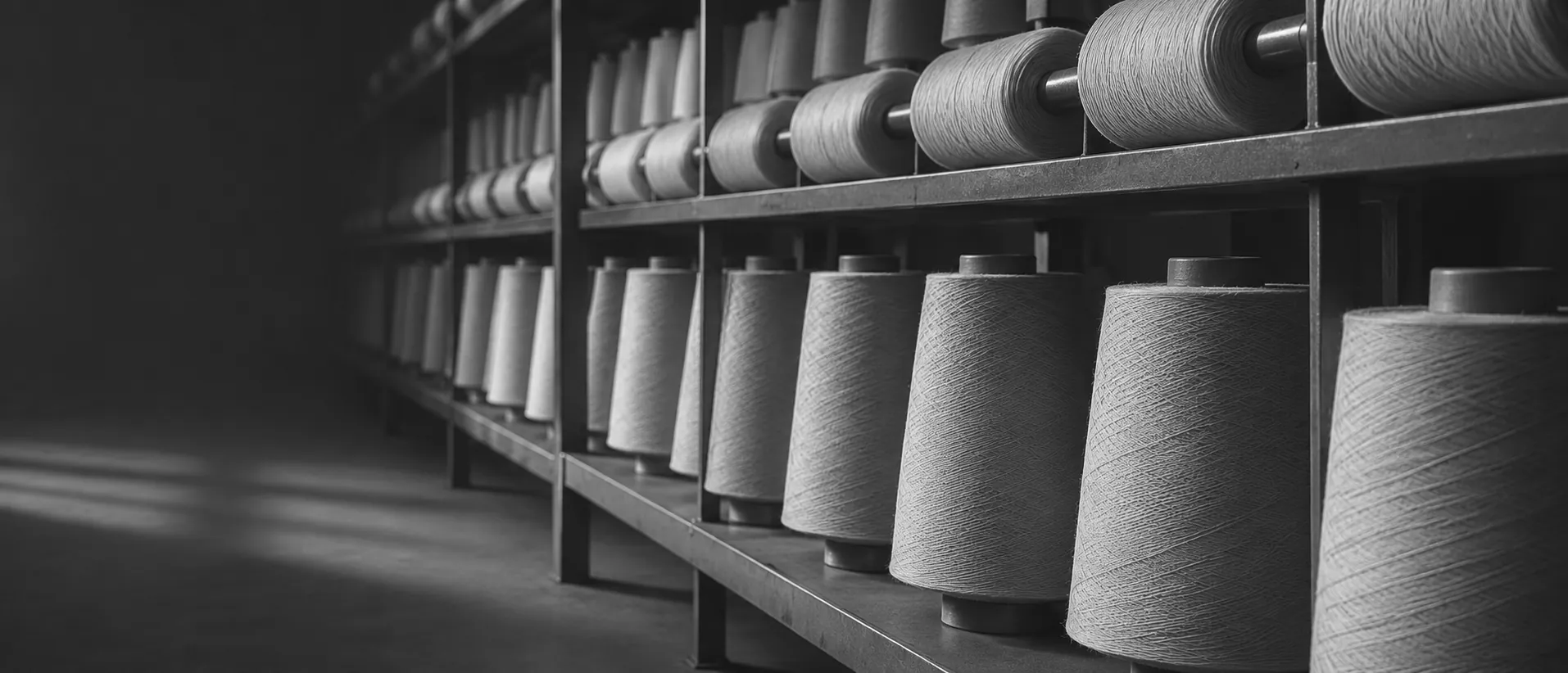
Spinning
Turns fibers into yarn: prepares them, aligns them, thins them and twists them so they hold together. The system used, ring or rotor, changes the regularity, hand-feel and behavior of the yarn. Two yarns of the same fiber are not equivalent.
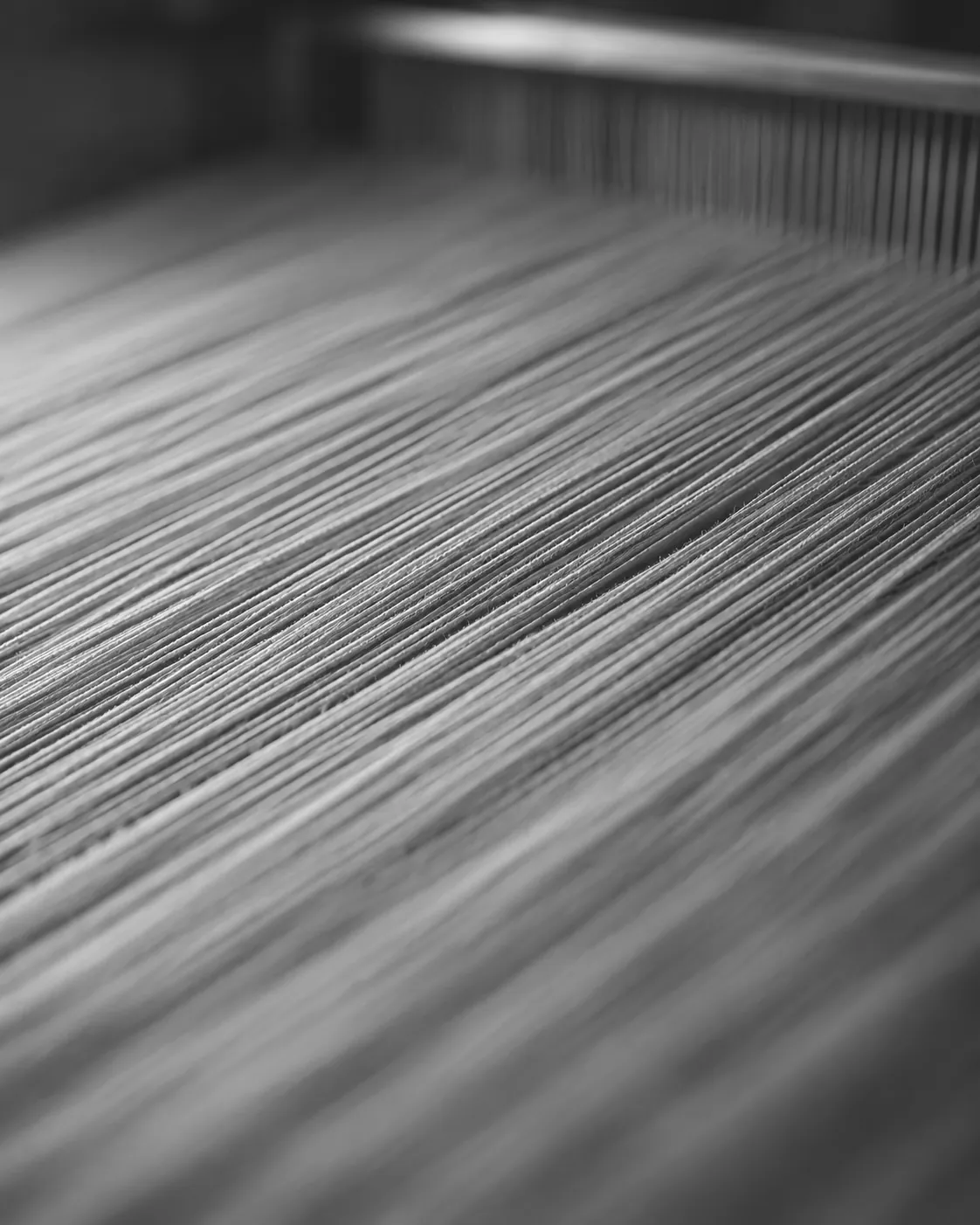
Weaving
Interlaces the warp, the lengthwise threads, with the weft, the ones that cross them. The shuttle loom carries the weft with an element that travels from side to side; shuttleless looms carry it with rapiers, compressed air or water. The workable yarns, the widths and the speed all change: water-jet, for example, works mostly with yarns that don't absorb water. Knitting is something else: there the fabric doesn't come from a crossing, but from a chain of loops.
Knitting
Two families. Circular machines work with needles on a cylinder and produce tubular fabric, to be cut and sewn. Flat machines have straight beds of needles and allow shaping and fashioning. A third category builds the whole garment on the machine, reducing cutting and sewing. Not everything called "seamless" is the same: a circular tube and a garment shaped on a flat machine are two different things.
Dyeing, printing, finishing
Dyeing colors the fiber, the yarn or the fabric. Printing draws on the surface: screen printing, rotary for long, repetitive runs, digital for more variety and short runs, without however eliminating fabric preparation and color tests. Finishing, with calenders, raising machines and sanforizing machines, decides lustre, softness and stability: how much a fabric shrinks doesn't depend on the fiber alone.
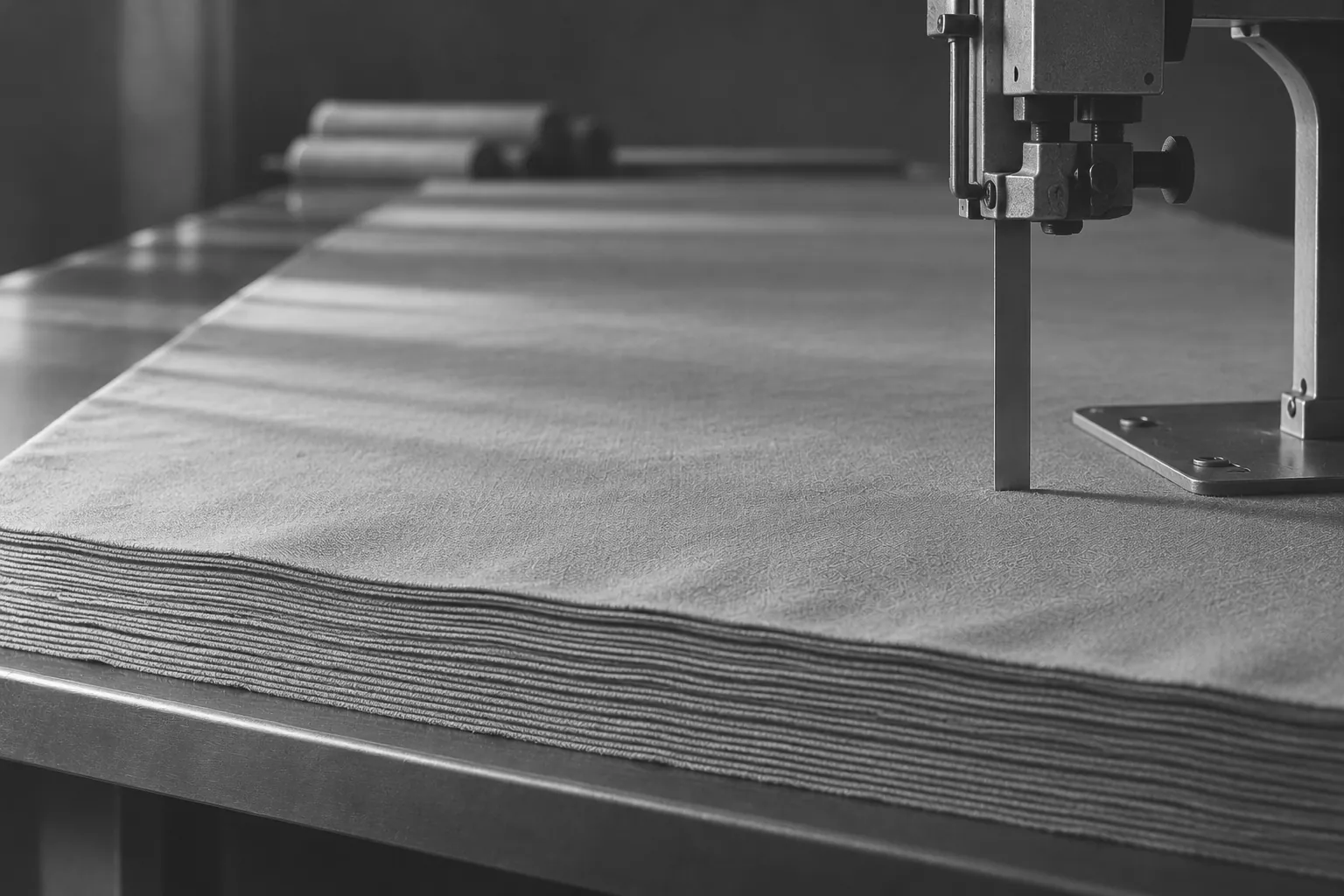
Cutting
The fabric is spread in layers following a marker. By hand, cutting is flexible but depends on the operator; with a computer-guided blade the marker repeats with more precision; the laser gives clean edges on thermoplastic synthetics but isn't right for everything. The choice affects the number of layers, precision and waste.
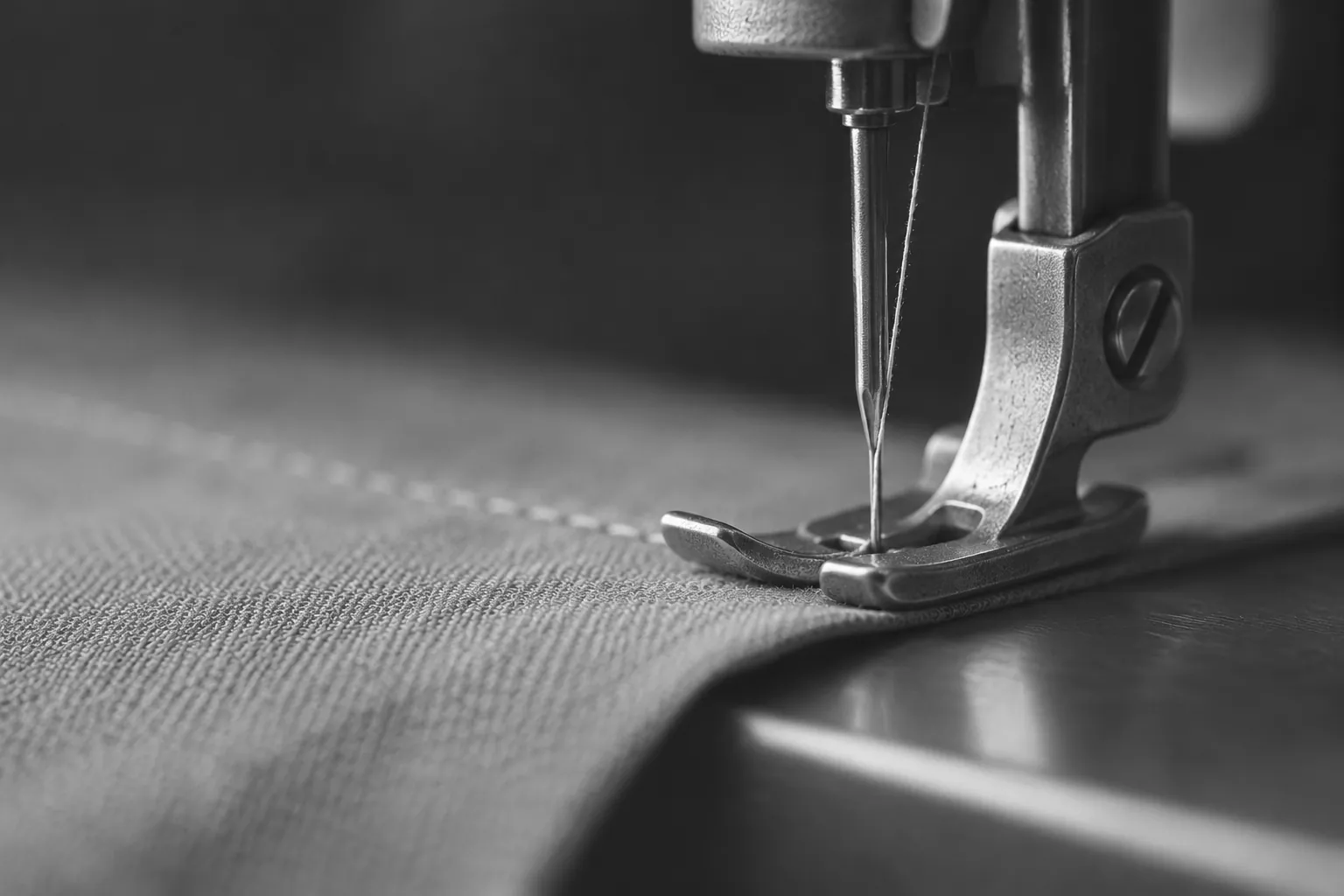
Sewing
This is where the pieces become a garment. The lockstitch, two threads interlocking inside the material, is stable and used for assembly and topstitching. The chainstitch forms loops and is more elastic. The overlock trims the edge and joins at the same time, and is typical of knitwear. The coverstitch makes parallel elastic seams, for jersey hems. Then there are buttonholes, buttons, bar tacks, blind stitches. Every stitch has a structure and a behavior under tension: one machine doesn't replace another.
Pressing and finishing
Presses, steam irons, vacuum tables and steam dummies set creases, lapels and volumes. Temperature, pressure, moisture and time can change the product irreversibly.
Quality control
Fabric runs across lit tables; the garment is checked with measurements and tests. Inspection doesn't replace expertise: it verifies against criteria fixed beforehand. If tolerances and acceptable defects haven't been defined, even the most careful inspection isn't enough.
04 — When the Machine Changes, the Design Changes
The seam is a design choice. Technical-jersey trousers with elastic inner seams and a clean hem speak the language of overlock and coverstitch, not of the lockstitch. A stitch too rigid on an elastic material breaks in wear; the wrong tension distorts or puckers the seam allowance.
Tolerances depend on the process. Automatic cutting repeats better than manual cutting, but doesn't eliminate variation: layer thickness, fabric stability and slippage all matter. A garment's tolerances are decided by looking at the material, the construction and the department that will actually make it.
Minimums don't depend only on the supplier. Rotary printing requires screens to be prepared, a jacquard requires a pattern to be programmed, dyeing in the bath requires recipes and quantities compatible with the plant. Digital printing reduces some preparations, not all. The minimum is the consequence of the entire process, not a number valid for everyone.
Timing depends on what is already in the department. A sample made with machines already in place follows a linear path. A process that requires special equipment, or an outside department, adds steps. There is no standard sampling time.
The practical rule: the earlier you check that design and machine are compatible, the less likely you are to discover it when the product is already developed.
05 — Where the Skills Are
Textile machinery has a geography, tied to the industrial history of each territory. Italy has a strong tradition of machine builders, concentrated in the north and center, next to the districts that use them: the two grew together, and technicians and users have known each other for generations. Other countries have other specialties. There is no country with the best machines in absolute terms.
For anyone designing, the right question is a different one: where are the skills to make this construction? A machine may be there while the person who knows how to use it with that material is missing. A department may have advanced equipment and little experience with a particular fabric. Production capacity is the meeting of machine, operator, maintenance, material and knowledge of the process.
06 — What This Means for Anyone Designing Today
Four things to keep in mind while developing a product.
- Compatibility: the machine must be able to work that material and that construction.
- Repeatability: what works on the first sample must also work at the planned quantities.
- Real cost: set-ups, tooling, special processes and machine time go into the costing from the start, not after it.
- Skills: not every department can do everything, even when the machine seems the same.
They must be considered early, in development and in the tech pack. An effective spec doesn't only describe the result: it lets the maker understand how to get there.
Today's machines are the result of two centuries of attempts. Tomorrow's, with automation, robotics and on-demand production, have a page of their own: the future of machines.
A design doesn't lose value by meeting constraints. It becomes more precise when you ask machines only for what they were made to do.
Knowing the machine is half the design. Knowing which department can really run it, on your material, in your quantities, is the work.
Open — 1 of 3 client spots available. I work with a limited number of clients at a time, so every project gets real attention.
Get a feasibility check for your product →